
Season 6 Wrap Up with Chris, Eddie, & Cody
Show Notes:
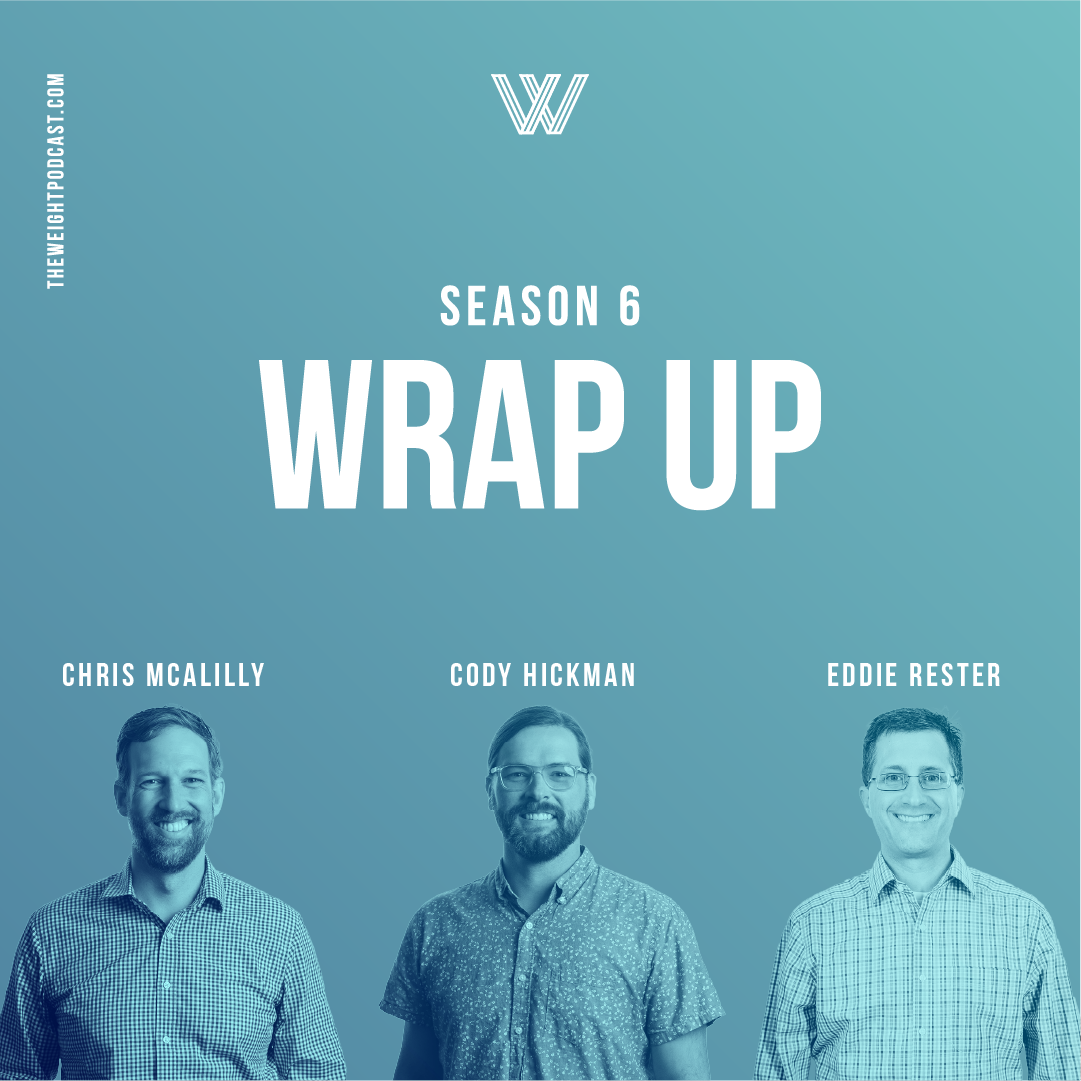
Cody Hickman joins Chris McAlilly and Eddie Rester as they wrap up the season with a thoughtful discussion on their favorite moments of the past episodes. They reflect on Christ-centered leadership, the significance of mental health, and generational differences in the workplace. Join along for a lighthearted episode that concludes the season.
Resources:
To learn more about Lover’s Lane UMC and Eddie Rester, click here.
To learn more about Oxford University UMC, Cody Hickman, and Chris McAlilly, click here.
Transcript:
Chris McAlilly 00:00
[INTRO] Leadership today demands more than technical expertise. It requires deep wisdom to
navigate the complexity of a turbulent world, courage to reimagine broken systems, and
unwarranted hope to inspire durable change.
Eddie Rester 00:22
As Christ centered leaders in churches, non profits, the Academy, and the marketplace, we all
carry the weight of cultivating communities that reflect God's kingdom in a fragmented world.
Chris McAlilly 00:33
But this weight wasn't meant to be carried alone. The Christian tradition offers us centuries of
wisdom if we have the humility to listen and learn from diverse voices.
Eddie Rester 00:43
That's why The Weight exists to create space for the conversations that challenge our
assumptions, deepen our thinking and renew our spiritual imagination.
Chris McAlilly 00:52
Faithful leadership in our time requires both conviction and curiosity, rootedness and tradition,
and responsiveness to a changing world.
Eddie Rester 01:01
So whether you're leading a congregation, raising a family, teaching students, running a
nonprofit, or bringing faith into your business, join us as we explore the depth and richness of
Christ centered leadership today. Welcome to The Weight. [END INTRO]
Eddie Rester 01:16
I'm Eddie Rester.
Chris McAlilly 01:17
I'm Chris McAlilly.
Cody Hickman 01:18
And I'm Cody Hickman!
Chris McAlilly 01:20
Who is Cody Hickman?
Eddie Rester 01:22
Today is an expanded episode of the Weight, not in time, but just in voice. Today, we've
welcomed our formerly long haired friend, Cody Hickman, who moonlights as our producer, into
the fray today.
Chris McAlilly 01:37
And why is he here?
Eddie Rester 01:38
Today's our season ending episode, the end of season six of The Weight. I didn't think we'd go
six episodes. We've gone six years. This is amazing.
Chris McAlilly 01:48
It's amazing. And on Thanksgiving Day, which is when this is coming out.
Eddie Rester 01:52
That's right, we always do the wrap up.
Chris McAlilly 01:54
And if you're enjoying your family, if you're trying to get away from your family...
Cody Hickman 01:59
We'll give you about a good thirty, forty five minutes of The Weight time.
Eddie Rester 02:03
This is how we should title the episode, "an excuse to get away from your family onThanksgiving".
Chris McAlilly 02:10
And to give thanks for a wonderful season, which we'll be doing.
Eddie Rester 02:13
It has been a wonderful season. We're going to talk about some of our favorite episodes,
maybe some of what we've learned and glean through the years.
Chris McAlilly 02:13
Years?
Eddie Rester 02:20
Years.
Cody Hickman 02:23
I can barely remember, like a few weeks ago.
Chris McAlilly 02:27
Cody is working, and so it's a short memory time horizon.
Eddie Rester 02:33
But I was gonna say, then we got to carve out some time for some Festivus, where I can air
grievances against both of you.
Cody Hickman 02:40
Now, before we get there to the Festivus, over any other thing. Why would you just want to
save all of it for later?
Eddie Rester 02:45
Let's just save all of it. But why am I doing this this year? Because I got a problem with some of
you people.
Cody Hickman 02:54
There's only two of us...
Chris McAlilly 02:57
And everyone listening.
Cody Hickman 02:59
...grievances with our audience.
Chris McAlilly 03:05
Oh, man, yeah, this is the sixth season. It's been a good season, Eddie. What was your favorite
episode? Go ahead, come on. Come in, strong.
Eddie Rester 03:14
You know, I think we started. We started the year with Annie Downs.
Chris McAlilly 03:19
That was good.
Eddie Rester 03:20
And it was a great episode. One of the things I love about Annie Downs is that she reminds us
that the church is not what it used to be in terms of it's all married people with kids, and really
is a voice for the place of single adults in the life of the church. And equips not just single
adults, but equips churches for how they speak and they talk in a way that is much more
broadly inclusive of all people who are coming and particularly young adults who are getting
married much later, if they get married at all.
Chris McAlilly 03:58
Annie Downs was a great conversation. We had some great conversations with folks who have
wide reach, wide audience. Annie Downs is one of them. One of the things that I remember
about that particular episode is that she is a professional. She is able to zoom through, kind of
the podcast medium to make you feel like you're right next to her. I don't know it was just...
she had a warm presence. And one of the things that she did this year was talk through
seasons, life as kind of a series of seasons. And she began in winter. So things were difficult,
but she was kind of going to travel through the year and lead her community through a
conversation about life in different seasons. And that was a good way to start the year. Go
ahead.
Eddie Rester 04:55
I was just going to say another episode that I really loved was Tom. Tom Nelson is early May,
and talked about some of the things they do at their church. One of the things that I'm stealing
from him, we're actually going to use it at Lovers Lane in the fall, is just bringing people up to
talk about how faith is active in their day, how you bridge the gap from Sunday to Monday, and
bringing people up just to simply say, what are you going to be doing tomorrow at this time?
What does your faith have to say to that? And how can we pray for you? And I just think that's
so powerful in terms of helping people think about what's happening on Monday, Tuesday,
Wednesday, Thursday, Friday, as a part of the life of faith. And for me, I still think about that
episode.
Chris McAlilly 05:40
Yeah, Tom Nelson runs an organization called "Made to Flourish," and he's thinking about,
essentially, how do you empower people to integrate their faith, their work, economic wisdom
for the flourishing of their communities? And, yeah, that was a phenomenal conversation. It
reminded me a lot of, I don't know if the audience knows the name Tim Keller, but a lot of the
work that Tim Keller did at Redeemer Presbyterian New York City seemed to be received by
Tom Nelson and then kind of offered in a new way in the Midwest. I think He's based in Kansas
City, and I did not know of his work until recently.
Chris McAlilly 06:27
I'm always looking for people who can help bridge the conversation between faith and work.
How do you integrate your life, your faith and your work? And yeah, really enjoyed that
conversation as well, I like the episodes, every season where we move away from kind of a
serious topic, and maybe we move into a conversation about art or music. Dan Forrest is a
composer and has written some extraordinary pieces of music, leading people into worship,
particularly traditional music. And the conversation with him was awesome. What do you
remember about that one? Eddie?
Eddie Rester 07:11
Well, I've just been a big fan of Dan Forrest forever, and just his music. And someone who can
bring ancient texts to life in a new way, I think is important for us. I think his vision of beauty
and how beauty is important to faith, I think is critical for us. I think sometimes we lose sight of
how important it is for us to engage in the beauty that God gives to us. That God is woven into
the fabric of our world. And Dan gets that, and he puts out some amazing, amazing music in
the world. And so if you're not familiar with Dan Forrest, just go to YouTube, type in Dan Forrest
and just start listening.
Chris McAlilly 07:56
We had this conversation cutting an idea with a college student who's going to be preaching for
us at the end of the year. And I was just blown away with... we asked him what he was
preaching on and we kind of gave him carte blanche to just pick a text. And the text that he
picked was Revelation seven, this image of the end of all things, where the throne of God is
surrounded by angels and archangels and all the company of heaven and all the saints. And
they're singing with one full voice and an offering back to God, glory and praise and honor and
Thanksgiving. And he started talking about what he was going to preach on, and why it was
important, and how it's connected to the mental health of young people.
Chris McAlilly 08:42
And we've just received such an amazing gift that's come to us from God as our Creator. And of
course, we should just offer this back to God. This gift, this glory, this praise, this honor. And he
kind of led us through how he thinks as a college student about the importance of worship, the
power of worship, how to worship. I was just blown away by it. I think that the Dan Forrest
conversation for me is one of those that helped remind me that not everything we do is to
produce something, to create something. Sometimes we just need to waste time in worship
with beauty and music. And that conversation kind of led me in that direction.
Cody Hickman 09:23
That makes me think of Rachel Jordan. Is that right? The marine biologist we had, I think, is
Rachel Jordan.
Eddie Rester 09:30
I'd have to go back. I'd have to go back.
Cody Hickman 09:31
I think that's right. If not, I'll correct in a little bit. She talked about, she's a marine biologist.
She does all this work in ecology. But through that has like... being in nature and doing her
study and all that leads her to the worship of the Creator. And so I think that reminds me of
that, that connection of what is work and faith, and how do those line up, and how you know...
most people aren't working in a church. How do you live out your faith daily? How do you
worship daily? And for her, it's her work as a marine biologist.
Chris McAlilly 10:06
She said in that episode Saint Irenaeus, back in the fourth century, one of the early church
fathers, the initial step for a soul to come to knowledge of God is contemplation of nature. It's
contemplating the created order, the beauty and the wonder that can be awakened in us as we
consider the work of God. Certainly that leads to worship, and some of that can be in the form
of music, in the form of praise. But for Rachel, it was really just standing before the mystery or
the awe, or, you know, underneath the sea, like doing deep dives. I know that's one of your
passions Eddie is diving and just exploring the natural world and its complexity and its beauty.
And that led her to worship. I forgot about that episode completely.
Cody Hickman 10:52
Did I get the name right?
Chris McAlilly 10:52
Yeah. Rachel Jordan, you crushed it. Nailed it.
Cody Hickman 10:54
Also, Eddie, I really, really want to see you like in a full wet like... I want to see you walking on
land with flippers. That's mainly what I want to see.
Chris McAlilly 11:02
That's our picture for this episode.
Eddie Rester 11:03
You've got a video of me walking in my wetsuit with flippers, the whole gear for a promo video
for something.
Cody Hickman 11:10
Man, I totally forgot about that.
Chris McAlilly 11:12
It's out there on the internet. Someone find that video and put it out there again.
Eddie Rester 11:16
Cody, is your brain rotting? What's going on?
Cody Hickman 11:18
Yes! As Chris said, I have four kids. My brain is full rot.
Chris McAlilly 11:24
Eddie, do you ever get in that gear? You have that gear at your house? You just ever get back
in the... you have a pool in your backyard now...
Eddie Rester 11:27
I have a pool in my backyard now. All I need is a tank.
Chris McAlilly 11:31
Put this out on... do videos on social media during Thanksgiving. Today's Thanksgiving, the
people need this, Eddie. Everyone needs to see you in a wetsuit, jumping in your pool, man,
come on.
Eddie Rester 11:41
I will not be. I will be away from my- I would do it. Let me just say out loud, I would do it. But I
will be away from... it would be, I think, exclusive Weight podcast content.
Cody Hickman 11:54
It would be highly exclusive, that's gonna be on the Patreon later.
Eddie Rester 11:58
Patreon, yes.
Chris McAlilly 12:01
Oh man, nobody wants to see that. Nobodys going to pay for that.
Eddie Rester 12:05
One of the threads that I think we've pulled almost every season, I'm so glad that we do, is just
mental health as well. I think about Warren Kinghorn at Duke talking about that, and Philip
Clayton, who talked with us about suffering, John Swinton as well. We had Matt Campbell, so
many folks helping us think about, how do we make sure we're pursuing healing? And I think in
our world, thinking of that, making sure that we're talking about that. It's important to me. I
think it's important to folks who are listening that just stay with it, stay on the journey. Grab
some new tools along the way, if you can as well.
Chris McAlilly 12:56
I think that this is one of the areas that I found myself in terms of intellectual curiosity, in terms
of what am I gonna pick up to read about if I'm not reading for a sermon or reading for work.
It's just exploring the possibility for spiritual healing, the physical, mental, emotional healing.
How It works that people kind of find their way out of some of these really dark moments. And I
will say these conversations all them together, it might be worth at some point, like putting
them out together as a... just kind of a compilation of the wisdom through the seasons.
Chris McAlilly 13:35
There's a lot through mental and emotional health. And I think what I the collective, all of this
conversations together have led me to a place where I have more confidence that people can
work through difficult things. So if you really are, you know back and you're avoiding your
family on Thanksgiving because you have a dysfunctional family, or their riffs or fissures or
brokenness that emerge when you're with your family on a day like Thanksgiving Day, or as
you move through the holidays, it might be helpful for you to just step away from some of
those environments, go engage some of those episodes, and maybe find some confidence and
some hope that it doesn't have to be this way forever.
Eddie Rester 14:20
And one of the episodes with Matt Campbell, which was just a few weeks ago, if you want to go
back and hunt that down, it was the primal five, and he just talks about some basic things that
our mental health hinges on that isn't therapy. It's not doing any of that work. It's simply
making sure you're taking care of sleeping in some basic activity, and being outside and eating
well, so it's nothing other than just making sure you're taking care of the basic parts of your
life.
Chris McAlilly 14:54
I enjoyed meeting one of your friends, David McDonald, a seminary classmate. He has a radical
approach to...
Cody Hickman 15:04
Can't believe that was this season.
Chris McAlilly 15:05
I know it was early in the season.
Cody Hickman 15:05
That was great.
Chris McAlilly 15:05
It was a great conversation. Eddie tell folks about David and his approach to ministry.
Eddie Rester 15:12
David's one of the most creative people I've ever known. His church, West Winds. He stepped
out of that just doing some consulting now. But at West Winds in Jackson, Michigan, (I) went to
visit him one time. It was right after they had an Old Testament series, and it was a young
church, so they brought in a couple tons of sand, put it in the worship area, including where
people sat. They invited people to sit on pillows instead of in chairs, and to write prayer
concerns all in the back of the chairs with ink. But what he was doing was finding creative ways
to engage people in the Gospel. And I don't think where I am, bringing a couple tons of sand in,
would be helpful. But how do we think creatively? And one of the things that he said was that
he never uses an idea twice.
Cody Hickman 16:09
That stood out to me.
Chris McAlilly 16:10
I would say that feels like a bad idea, but it may be a bit of an over correction. But in general,
church cultures can get stale. They can get stagnant. And I think what the conversation
reminded me of is the importance to push beyond comfort levels, especially when things get
stagnant ourselves. Sometimes we have to do new things, not because anything's wrong, but
to continue to lead into the creativity of God.
Cody Hickman 16:43
And I think it doesn't always need a floor full of sand. I mean, a simple thing that you could do
this Sunday or the next Sunday is just, rearrange the order of your service, just a little bit,
tweak one thing. Move one thing from one place to another. And small things like that can
make big differences, because it just... Recently, we moved the offering time to the back end of
the service instead of after the first set of songs. And we did that for a few weeks, and then we
ended up moving it back because I didn't like it, but we tried it. But it creates just a small shift
and it lands a different way.
Chris McAlilly 17:17
Eddie, what are you doing creatively these days?
Eddie Rester 17:19
We actually, during the season of Advent, we're moving some things around the service to
create space for more music, for more singing from the congregation because...
Chris McAlilly 17:33
Is that because people don't want to hear you preach?
Eddie Rester 17:35
That's exactly, they want to hear less of me, more themselves.
Cody Hickman 17:39
That checks out.
Eddie Rester 17:41
And so what they're doing is, just our series is based on the songs that are in the gospels
around the birth of Jesus. And so making sure that people have that opportunity to sing. So
that's one of the things. We're trying some different things to get people engaged. And so
again, one of the things that an episode of Simon Sinek taught me, and if you don't know Simon
Sinek, he's got great podcasts, go look it up. But in one of his episodes, his guest talked about
organizations need to make more first pancakes. I think I've shared this with you all before.
First pancakes are the things... nobody eats a first pancake. It's terrible. But if you don't make a
first pancake, you don't get to a second pancake or third pancake, which are edible. And so if
you're not doing something creative, if you're not trying something you're not going to get
something that's edible. I'm not sure the metaphor really needs to stretch that far.
Cody Hickman 18:36
I do remember one thing we did. Eddie, this was back when you were still here. I think this
would be considered creative. We... you... you got a spray tan.
Chris McAlilly 18:47
That was very interesting.
Eddie Rester 18:49
But it didn't last, if you remember. Because I had a funeral the next day, but we raised a certain
amount of money, I think for my dancing on dance, like the whole dance, like the star. I can't
remember what the... anyway, I got...
Chris McAlilly 19:04
But I do think so we did this fundraiser. It was make Eddie orange.
Eddie Rester 19:09
Yeah, make Eddie orange.
Chris McAlilly 19:10
And then, it was, like, the level of orange that Eddie would be based on the number. You went
in to get it on a Thursday. We shot the video.
Eddie Rester 19:19
We met the goal.
Chris McAlilly 19:21
And the goal was to get Eddie to be orange on Sunday.
Eddie Rester 19:25
On Sunday, yes.
Chris McAlilly 19:26
But a funeral arose on Saturday.
Eddie Rester 19:30
There was no way I was going to torture... Have these people who didn't know me show up and
be like, why is your preacher orange?
Cody Hickman 19:38
So if you're looking at fundraiser options, painting your pastor orange is always a good option.
Chris McAlilly 19:43
I think... we can pay this forward to Lovers Lane. I think Eddie is willing to get spray tanned
again. Lovers Lane staff, if you're listening.
Eddie Rester 19:52
You're asking why we need a festive section of this episode, and what you're doing not just to
me, but to our dear listeners out there, they're saying Eddie should fire back at these morons.
That's what they're saying. I can feel that on Thanksgiving Day.
Chris McAlilly 20:12
And this is why we may need to return to Scripture. We did that a lot on the podcast. This...
almost said semester, this season, AJ Levine, great conversation about wrestling scripture.
Eddie Rester 20:24
I couldn't believe we had a chance to talk with with her. She's just a giant in the field of Biblical
Studies. In such a gift to get to talk with her, and for her to get to slam me at the end of an
episode when I said something about the Greek, and she reminded me.
Cody Hickman 20:41
I forgot about that a lot of people just slam you.
Cody Hickman 20:46
Do you have a grievance for her too later on this episode?
Eddie Rester 20:47
That's right.
Chris McAlilly 20:47
Zach Lambert, we talked about better ways of reading scripture. We talked to Mark Chancey
about the way in which scripture operates in a public square, yeah, so how to read scripture?
How to read it well? The key point, if you don't go back and listen to any of those episodes, is
that everybody interprets, even the people that don't think they interpret. Everyone is
interpreting the Scripture. If you know that you're interpreting, you can be faithful. You can be
responsible in your interpretation. If you don't know you're interpreting, maybe you need to
think a little bit more about how you're reading the Bible on a deeper level. I think it's a more
mature and faithful way to read. It's just to know that you're interpreting and that there are
multiple interpretations of different texts. All of those conversations, I think, were helpful and
they were well received. A lot of people listen to those.
Eddie Rester 21:39
One of the episodes that I think is a more local episode for Oxford and for Mississippi, but I
think is worth folks beyond Oxford and Mississippi listening to, is the episode with Robert
Khayat, the former chancellor of the University of Mississippi. A beloved former leader of the
university, beloved member of the community, and also a man of great wisdom and character.
Chris McAlilly 22:09
This is getting into hero territory, folks that... you look particularly in Mississippi, you think
about people who shape the trajectory, the state over the last fifty years. And you think about
key people, he's on a short list, in my view. I mean, one of the top five leaders of his generation
in terms of setting a trajectory. One of the things that has happened recently is that this
narrative that Mississippi is at the bottom of every educational health outcome. You know,
we're fiftieth of fifty in most markers of education. That's changed, and literacy rates have
drastically improved in the state. And I see that as downstream of this emphasis that Dr.
Khayat put on excellence in public education at the research university level, and the way in
which that emphasis on education has continued to shape and reshape what the state thinks it
can be. He is the kind of leader who empowers and encourages others to be more than they
think they can be. I've experienced that, Eddie, you've experienced that from him. And yeah,
what a gift to sit down in his home and to talk to just a beloved Mississippian and an incredible
leader. Definitely worth your time. You can as you can tell, I love that episode.
Eddie Rester 23:43
I think about the Barksdale family and their investment, not only in Ole Miss because of him,
but ultimately, I would say that Dr. Khayat set the stage for what Jim Barksdale did in reading in
Mississippi, which changed the test scores, which changed lives, which ultimately is changing
the narrative of educational attainment in Mississippi. And I think you're right. I think you can
trace a lot of things positively that happened across Mississippi to Robert Khayat.
Chris McAlilly 24:19
I will say, maybe you're not a Mississippian, and maybe this is not your area. Listening to the
conversation helps you to develop, the capacity to hear what it sounds like for a leader to
choose affection for a place and its people as a kind of a beginning point for charting a vision
for where an institution might go. And I do think institutional life, that's something that that I
learned from Dr Khayat, that institutions, people flourish within the context of institutions.
Another person that has taught me, has taught us, that lesson again and again and again we
were so grateful to have again on the podcast, the president of Belmont University, Greg Jones.
Greg is another one of our heroes and friends who is doing amazing work in the Nashville area.
He was talking about kind of this trajectory of leading with hopeful imagination. Love that
conversation too.
Eddie Rester 25:22
He is an innovative leader. He sees what institutions can't see, but then, which is not that rare
of a gift, people all the time say we should be doing this. But his capacity is not just seeing the
hopeful future, but building pathways for people to do that. And sometimes that's changing
culture. Sometimes it's naming culture. He had a lot to say about that. What happened here at
Lovers Lane is that, after somebody listened to that, they printed out his soul acronym here
and put it up in the staff kitchen.
Chris McAlilly 25:58
That's cool, the soul framework, I think, is what he's calling that love, that conversation that
was really good. Eddie, what about your friend? Robert St. John, that was a great conversation.
Eddie Rester 26:11
Great conversation if you know somebody, or maybe you have a friend or loved one who's kind
of early in recovery just coming out of addiction, Robert St. John's story is what can happen
when you commit to that. When that becomes a part of who you are, that journey of recovery
and how it just can impact you long term. But not just that, how you begin to turn that so that
you open your life, your work, so that it enables other people to pursue healing, a new life as
well. I got to know Robert when I was in Hattiesburg in the late 1990s, early 2000s, and I knew
him at first because of his restaurants. And then I knew him because of some of the nonprofit
work that he did. But I also got to know him as one who deeply understood what it meant to
fight addiction, but also to create spaces and places where other people in that can find their
way forward as well.
Chris McAlilly 27:20
One of the episodes that I think that I was not... I just being honest, I was not looking forward
to, because I felt like it was Eddie bringing in one of his bag of leadership tricks, this kind of
generational leadership thing. Sometimes Eddie will bring in kind of these leadership contexts.
I'm like, ah, it's just another one of Eddie's thing.
Eddie Rester 27:42
Let me just say, if there's ever an episode for folks who are listening that you don't like, just
blame it on me. I think that's what you're getting at here.
Chris McAlilly 27:48
But here's the thing, so this was probably the most surprising episode of the season to me.
Multi generational organizations with Philip Gwoke, I think is the guy's name, and that was a
conversation about generational research. What do you call... it's like the Gen Z stuff, the
millennial stuff, people that put people in these boxes and categories. I don't even know what
generation I'm a part of, but whatever the one is that resists labels. And this was really, really
helpful to me because it helped me understand people that I'm working with that are ten or
twenty years older than me, people I'm working with are ten or twenty years younger than me.
Fascinating conversation about how different generations engage work and the workplace
expectations, etc. You guys remember that one? That was a great one?
Cody Hickman 28:39
I was just about to bring that one up, and just all the really leadership specific episodes we did.
So, I mean, you go back to Greg Jones, like you said, Phil Gwoke, we had Matt Miofsky and Bill
Simmons. I think those are a few of the ones that were really on the nail of leadership and
church leadership. And there's just really good, rich information. I had this quote from Matt
Miofsky that I pulled up that... this is one that stood out to me. Said "I was so scared of failing
and I was so obsessed with not failing, but I spent very little time thinking, what happens if this
thing actually works?" I just assumed most of the things I do are going to fail.
Eddie Rester 29:02
But it's a different mindset. Matt's one of those incredible leaders who has kind of turned the
corner and is doing amazing things in St Louis. I want to go back to Phil Gwoke, because I think
people like to make light of generational differences. It's a big deal. We make light of
generational differences to our own demise, I mean understanding at least a little bit of what
people are looking for in work, understanding a little bit of how to manage someone who has
grown up in a different generation than you is so significant, because if you don't give a Gen Z,
say, an input, at least a sense of ownership, they're not going to show loyalty in the same way
that you know Gen X, my forgotten generation, we're going to be a little bit more direct. And
cynical, is not exactly the right word, but we're going to be direct about things. Tell us what you
think. If you do that with Gen Z, they're going to have a different response than my generation
would have.
Chris McAlilly 30:32
It might be helpful to have him back on again next season. I would love to talk more with him,
because I think this is an area where I just don't have a ton of... I've not done much reading or
research in this area, and I think I would gain a lot from a deeper conversation with him,
particularly as it relates to managing. I think you could do a deep dive on different generations
and management styles related to those. The other place where I think he might be interesting
to talk to is every church I know is navigating, and I think it's probably nonprofit. Christian
nonprofits, other nonprofits, are thinking about... We make sure that our funding models are
going to be able to survive a kind of a generational change in who's going to be leading in
those organizations.
Chris McAlilly 31:27
We have at our church, a number of wonderful, seasoned adults who are in their 80s and 90s,
who've carried the burden of responsibility and leadership for a long time, and we're stronger
and better off because of their faithful leadership. But I do think that there is going to be a need
for another generation to take those responsibilities, and the conversation is going to have to
be radically different, because you can't start the conversation with obligation and duty. It's
going to have to be a totally different kind of conversation. For how a thirty something might
engage taking on ministry or financial leadership in a church context.
Cody Hickman 32:11
I haven't considered any of that much, because I feel like as a millennial, an elder millennial,
but a millennial, since I've been in the workforce, I've been like,"We're the youngest
generation in the workforce," and so it's like, oh, you old people got to figure out your stuff and
how you're going to work with us, and vice versa. But Gen Z is well within the workforce now
and I mean, we have awesome interns here at our church. I'm sure y'all have some there too,
Eddie. Our younger folks who are coming in, and I find myself... I honestly Eddie, I feel like in
my heart I'm old like you.
Chris McAlilly 32:49
He's old in his heart.
Cody Hickman 32:50
In my heart, and so that's how I approach stuff. And you can't, I'm learning that, and that Phil
Gwoke episode was really good for me.
Eddie Rester 32:57
I think he would be great to have back and even thinking in terms of how in churches, if you
think, well, churches doesn't matter. How do you work with volunteers? How do you understand
volunteers of different generations that are just so many different applications? Cody, let me
say one thing to you right quick. You built a library with dark wood, and you're hunting for a
rich leather sofa or chair for that room, you might as well get one of those robes and a pipe
buddy. You are an old Englishman.
Cody Hickman 33:27
I don't know if you think you're being mean to me right now, but we're on the same page.
Eddie Rester 33:38
No, I'm just trying to name your reality Cody. I'm not sure you fully get it, but your Facebook,
Instagram posts recently, the fact that you're still posting on Facebook, it floors me. I mean,
you're now of a certain generation.
Cody Hickman 33:56
That's because the Facebook marketplace, that's how you get the leather chair.
Eddie Rester 34:00
If you don't have a smoking jacket, I don't know who you are, you're feeling your...
Chris McAlilly 34:06
He needs the pipe. He needs the English tobacco.
Chris McAlilly 34:06
Here's what's gonna happen.
Eddie Rester 34:07
His hair this year. He's no longer a young man.
Cody Hickman 34:13
I know I'm becoming an old man. So my looks. Am I going gray pretty quick, not as quick as you
Chris, but it's coming up. It's going fast. I want to be there. I have to wait until I don't have to
sing anymore. So it's gonna have to wait until retirement, so I don't ruin my voice with the pipe
tobacco smoke. But I want that life. That's what I want. I want to sit back with my pipe and
read. Here's what I did. Here's what I did yesterday. When I got home from work. I got home, I
put... so stupid... I put on, like Civil War Battlefield instrumental music, and read a book about
the Civil War. That's what I did when I got home yesterday.
Eddie Rester 34:58
So you skipped the entire. I mean, there's an age where men turn to World War Two. You blew
right past that and went to the Civil War?
Cody Hickman 35:04
Yeah.
Chris McAlilly 35:05
That's fantastic.
Eddie Rester 35:10
I don't even know who you are anymore, Cody.
Chris McAlilly 35:14
There's not a good segue back to any podcast episode.
Cody Hickman 35:17
And that's Eddie's fault. He did that one.
Chris McAlilly 35:19
I'm trying to think about how to steer us back. We can't now. We're still...
Eddie Rester 35:22
Let me just say this. The episode last week was Jen Hatmaker, and we started the year with
Annie Downs. We end with Jen Hatmaker. It's been an incredible season. Jen Hatmaker
understands the brokenness of life in and through the church. She's still trying to figure out her
place in the church, but her life experience has opened her up to, I think, how God can speak
and move and allows her to lead people toward healing ultimately. And I'm thankful for her, I'm
thankful she took some time with us at the end of her book tour, before she took a break.
Chris McAlilly 36:07
What's funny about this is that my I told my wife, I was like,"Hey, we're gonna be interviewing
Jen Hatmaker for the podcast." She was like, "You're what?" And I was like, "Yeah, we're
interviewing Jen Hatmaker for the podcast." She's like, "this is a big deal. You've got to figure
this out. Read the book, you know, do your education? You gotta educate yourself." And so (I)
went back and did that, read her book, and it is an extraordinary book. I mean, she's another
person. We're punching a little bit above our weight with that conversation. It was really, really
good. I got a... as we were sitting here. I got a message from my friend Anna. I think it's helpful
to just kind of read a little bit of this.
Chris McAlilly 36:46
She said, "fan girling over here of your conversation with Jen Hatmaker, I followed her for years.
Devoured her book. Particularly relate to her religious background. Love your questions about
the narratives were given and developing self awareness. Her responses were amazing,
particularly the part where she said, largely prioritizing certainty as a mark of faithfulness and
spiritual authority." And her growing up in that, and that being a mark of obedience. And then
the way in which she kind of learned, maybe thinking of faithfulness in a more expansive way.
It was a great conversation. And, man, I think a good way to end the year. And it gave me, it
kind of put us on a high for looking forward to next year. I'm pumped to continue doing... we
are going to continue doing this, right?
Eddie Rester 37:37
We're continuing to do this. Cody gets too old to turn the knob, which could be anytime.
Cody Hickman 37:43
Yeah, my timeline seems to be moving quicker. I don't understand.
Eddie Rester 37:46
I'm not sure what's going on with you, Cody, but I'll be in town next week. We can talk this
week. Actually, when this comes out, we'll have seen each other.
Cody Hickman 37:55
That'll be nice.
Eddie Rester 37:56
The things that I'll say is that, Chris, that you're choosing to go to a beach instead of hanging
out with me and Cody next week. I am pretty mad about that. That's part of the Festivus
moment here.
Chris McAlilly 38:15
Oh, we're turning into Festivus now, okay, we just changed that. Now we're in accordances.
Eddie Rester 38:21
It's grievances that you're not going to be there. You've chosen to go on a trip with your family
instead of hanging out with us. I mean, I'm not happy about that. Cody, I understand that the
gift I gave you, you're no longer using your crocs.
Cody Hickman 38:37
Who said that. That's not true.
Eddie Rester 38:39
I check up on you.
Cody Hickman 38:41
I don't know who you're checking with. Let me tell you. I'll tell you exactly. I use my crocs
weekly to squash bugs. They're the bug squashers. They are also the Monday evening when I
forgot to take out the trash, and it's gonna be there in the morning, and so I need to make a
late night run to take the trash out. The crocs are my choice.
Eddie Rester 39:00
You're not lying to me?
Cody Hickman 39:02
I promise you. You can text Amy right now. She will tell you.
Eddie Rester 39:05
I will step back from that grievance.
Cody Hickman 39:07
Thank you.
Eddie Rester 39:08
My only grievance today is with Chris.
Chris McAlilly 39:10
Good. Well, I receive your grievance. You can file it in the complaint section, and I will take it on
board. I am not disappointed that I will not be seeing you.
Eddie Rester 39:27
Cody and I will be doing feats of strength when we get together.
Chris McAlilly 39:31
Please do include that in the exclusive content section.
Eddie Rester 39:37
The airing of grievances, feats of strength, we'll take care of those.
Chris McAlilly 39:39
Are you going to do push ups?
Eddie Rester 39:42
I can't share with you. You won't be there.
Chris McAlilly 39:44
I mean, can you do push ups?
Cody Hickman 39:46
That's a different question.
Eddie Rester 39:50
Until I had my leg injury...
Cody Hickman 39:53
Man that was so gross. We're gonna post that picture.
Chris McAlilly 39:56
That was so gross. Tell people, what you did. You had an injury. I know you need this is part of
your healing process.
Eddie Rester 40:05
Part of my healing. It's still an issue. I went to the Ole Miss Oklahoma game to root on the
Rebels. They won. After the game, we're greeting with a lot of people from Oxford. I stepped on
a wet bleacher. My foot slid across that bleacher and my shin slammed into the metal bleacher
in front and the adrenaline got me back to Dallas from Norman, but my legs... The entire lower
leg was swollen for weeks. Part of it's still swollen four weeks later, but you know, as Audra
says, "Eddie, at your age, healing comes slowly."
Chris McAlilly 40:47
I think this might be a good place to get your prognostication on whether or not Lane Kiffin is
going to stay with the Ole Miss Rebels or not.
Cody Hickman 40:57
We may know by the time this episode comes out.
Chris McAlilly 40:59
We may but I think it would be helpful to get on the record.
Eddie Rester 41:03
I cannot confirm nor deny that there will be a meeting I will be a part of on Monday that will be
a part of that decision. So if that meeting was or wasn't to happen, I don't want to be able to
influence how that's going to play out.
Chris McAlilly 41:18
So what I hear you saying is, you have no idea?
Eddie Rester 41:21
I have no idea. No idea. Regardless, it's been a great run.
Chris McAlilly 41:28
Yeah, it has been a great run here on The Weight season six. Been a great, amazing year.
Eddie Rester 41:32
See y'all late January, early February, for the start of season seven. We need a special logo.
Cody Hickman 41:41
It's gonna be a little different.
Chris McAlilly 41:42
What's gonna be different?
Cody Hickman 41:44
Well, we're gonna leave that kind of the other side of the veil. Yeah. So it's gonna be season
seven will be a bit different. It's gonna be exciting. It's gonna be really nice. I'm excited for it.
Chris McAlilly 41:56
I'm also excited.
Eddie Rester 41:57
We're finally getting paid? We're getting paid finally?
Chris McAlilly 41:59
That'd be nice. We've been waiting on that. That would be awesome.
Cody Hickman 42:04
Yeah, tell thanks to everybody at Lovers Lane for sponsoring all of us here.
Eddie Rester 42:08
Hey, thank you all for listening. It's so great to hear from folks, and to know that folks are in this
journey with us, and that we're, sometimes it feels like we're all over the board, but we know
that life is all over the board, and we're just going to keep figuring out how to talk about things
or at that intersection of culture and faith. I think that's important. So thank you all for being in
this with us.
Chris McAlilly 42:34
Peace. See you. Happy Thanksgiving, Eddie, to you as well.
Cody Hickman 42:38
Have a Thanksgiving, Eddie.
Eddie Rester 42:40
And to Cody.
Eddie Rester 42:40
[OUTRO] Thanks for listening. If you've enjoyed the podcast, the best way to help us is to like,
subscribe, or leave a review.
Chris McAlilly 42:51
If you would like to support this work financially, or if you have an idea for a future guest, you
can go to theweightpodcast.com. [END OUTRO]